



Eartec Ultralite ULSM HD Master Headset one-sided
Wireless intercom headset for Ultralite systems


€ 230.86
incl. VAT
194.00 € w/o VAT
in stock
ℹ Legal guarantee rights Shipping cost More from EARTECNo returned or B-stock items sold as new
One contact who knows the equipment
Not left alone if a defect occurs
Full input-tax deduction for business customers
article number: 12046 | manufacturer number: ULSM-HD | EAN/UPC: 0672225577485
The Eartec Ultralite ULSM HD is a single one-sided master headset for Eartec Ultralite intercom systems. As a master unit, it forms the central connection for direct wireless communication with compatible remote headsets.
The ULSM HD is used when a new Ultralite system is to be set up or an existing configuration is to be supplemented with a suitable master unit. The one-sided design keeps one ear free and is therefore ideal for workplaces where additional ambient noise must be heard.
- One-sided master headset for Ultralite systems
- Direct communication with compatible remote headsets
- No separate beltpack required
- Suitable for flexible system configurations up to 5 participants
- Full duplex communication over 1.9 GHz DECT technology
- Up to 400 meters range, depending on the environment and operating conditions
- Microphone arm with 270 degree swivel range, can be worn on the left or right
- Microphone muting by folding up the microphone arm
- Replaceable Lithium battery for flexible operating time
The ULSM HD is suitable for direction, camera, stage and technical management when a compact master unit is required for wireless team communication
- Starting point for small Ultralite intercom systems
- Film, studio and event production
- Communication between director, camera and crew
techn. Specs▲
Specifications
| Standard | DECT | DECT 6.0 (Digital Enhanced Cordless Telecommunications) |
|---|---|---|
| Frequency | USA | 1920 – 1930 MHz |
| Frequency | Europe | 1880 – 1900 MHz |
| Frequency range | Preferred Frequency | TX/RX: 1921.536 – 1928.448 MHz |
| Reception | Tuning Range Receive | 1921.536 – 1928.448 MHz |
| Performance | Max. Transmission power | 100 mW |
| Transmission | Usage Type | TDMA |
| Transmission | Channel Tuning Step | 1,728 MHz |
| Transmission | Channel Bandwidth | 1,728 MHz |
| Transmission | Modulation | GFSK |
| Transmission | Transmission Speed | 1,152 Mbps (Baud Rate) |
| Transmission | Duplex | Time Division Duplex (TDD) |
| Audio | Speech Encoding | ADPCM / 32 kbit/s |
| RF Access | Access Method | Time Division Multiple Access (TDMA) |
| Range | Max. Distance | approx. 300 yards (line of sight, depending on terrain) |
| Power supply | Headset battery | Rechargeable Lithium 3.7 V / 800 mAh / 3.0 Wh |
| Power supply | Charger | AC adapter: input 110 – 240 V AC |
| Loading time | Charge Time | approx. 3 hours |
| Operating time | Operation Time | approx. 5 – 6 hours |
| Environment | Operating temperature | 0 °C to 40 °C |
| Environment | Storage | -10 °C to 50 °C |
| General | Weight | approx. 4 oz (≈113 g) |
Questions & Answers▲
How many people can communicate with this headset at the same time?
The system supports up to 5 units that can communicate directly with each other. If more than 5 devices are used, an additional base station can be purchased.
What range does the master headset have?
The range is up to 400 meters with full duplex communication.
How long does the battery last with continuous use?
The lithium batteries offer up to 6 hours of operating time with one battery pack.
Can the microphone be worn on both the left and right?
Yes, the microphone and microphone capsule can be worn both left and right thanks to a 270 degree swivel angle.
How does muting the microphone work?
When the microphone is turned vertically upwards, it is automatically muted.
Can the battery be changed during operation?
Yes, the battery can be quickly replaced, allowing almost uninterrupted operation.
What radio technology is used?
The system uses DECT technology for crystal-clear communication.
Is the headset approved in Europe?
Yes, this headset series has European approval. Registration papers can be requested from the manufacturer.
What is the difference between master and single headsets?
The Master Headset is the base unit with integrated transmitter and receiver, which is required for operation with other ULSM and ULDM headsets for a full duplex intercom system.
In which frequency range does the device work in Europe?
In Europe, the device operates in the frequency range from 1880 to 1900 MHz.
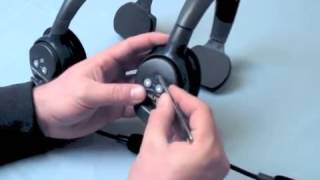
Videos

Documents, files, links ▲

product safety (GPSR)▲
